
When I was thirteen, I spent part of the summer at my aunt and uncle’s home in Beaulieu-sur-Mer, on the Côte d’Azur, with my brothers, cousin and her friends. Beaulieu is a beautiful, rather glamorous little town, but there was nothing glamorous about us. My uncle worked for the railway, and was tasked with monitoring the barriers at a nearby level crossing, and their home was part of the old station. It was tiny, but it holds some of the biggest memories of my childhood. It was also rather special because we would spend a whole month there, perhaps even longer, and my parents would only stay one week at the start and a few days at the end. Other than that, it was just us kids all day, while my aunt would be working in Nice. We would spend entire days at a beach or at a party with some of my cousin’s friends. We would cycle around or just walk by the marina.
This place saw me growing up, the joy, the stears, and the heartbreaks, and as I started working in a beach restaurant just down the road, it became my pied-à-terre, and then again the following year when I worked in Eze Village, where I learned what Michelin standards meant and what being a chef asked of me.
I always went back to this place when I could, until last year when I went for uncle’s funeral. The place had been tored down. Nothing was left but the crossing, that, apparently, truly needed no monitoring. Something broke inside my heart as if something was trying to rip the memories from my mind as I remembered events after events, since I could remember, inlcuding a few flashes of my aunt’s wedding when I was just 3 years.
I also remembered that every summer, each village and small town along the Côte d’Azur took its turn hosting a week of celebrations. There were open-air balls where everyone came together: grandparents, parents, teenagers and children. I danced the tango and waltz with somebody’s grandmother, then danced to pop music with teenagers my age. We created friendships that travelled from one village ball to the next. The Côte d’Azur has a long tradition of local festivals, shared meals and outdoor dances — the kind of occasions that bring generations together under the night sky.
One night — or perhaps I should say early one morning — we came home from a ball at around three o’clock. My aunt asked whether we wanted something to eat. Of course we did. But when she said one magic word, we replied in unison, as if it was the most natural thing. We laid the table and sat down to the most delicious beef tongue stew, warm and rustic and completely perfect at that hour.
That is what I want to bring to this recipe: not only its rustic flavours, but the simple joy of gathering around good food. A meal does not need to be elaborate to become a memory. Sometimes it is a warm bowl in the early hours, a crowded table, and the feeling of being part of a tribe.
Today, I want to invite you to my 13th year, when everything was still magical, and discover simple cooking, the rustic flavours, and the simple joy of eating great food.
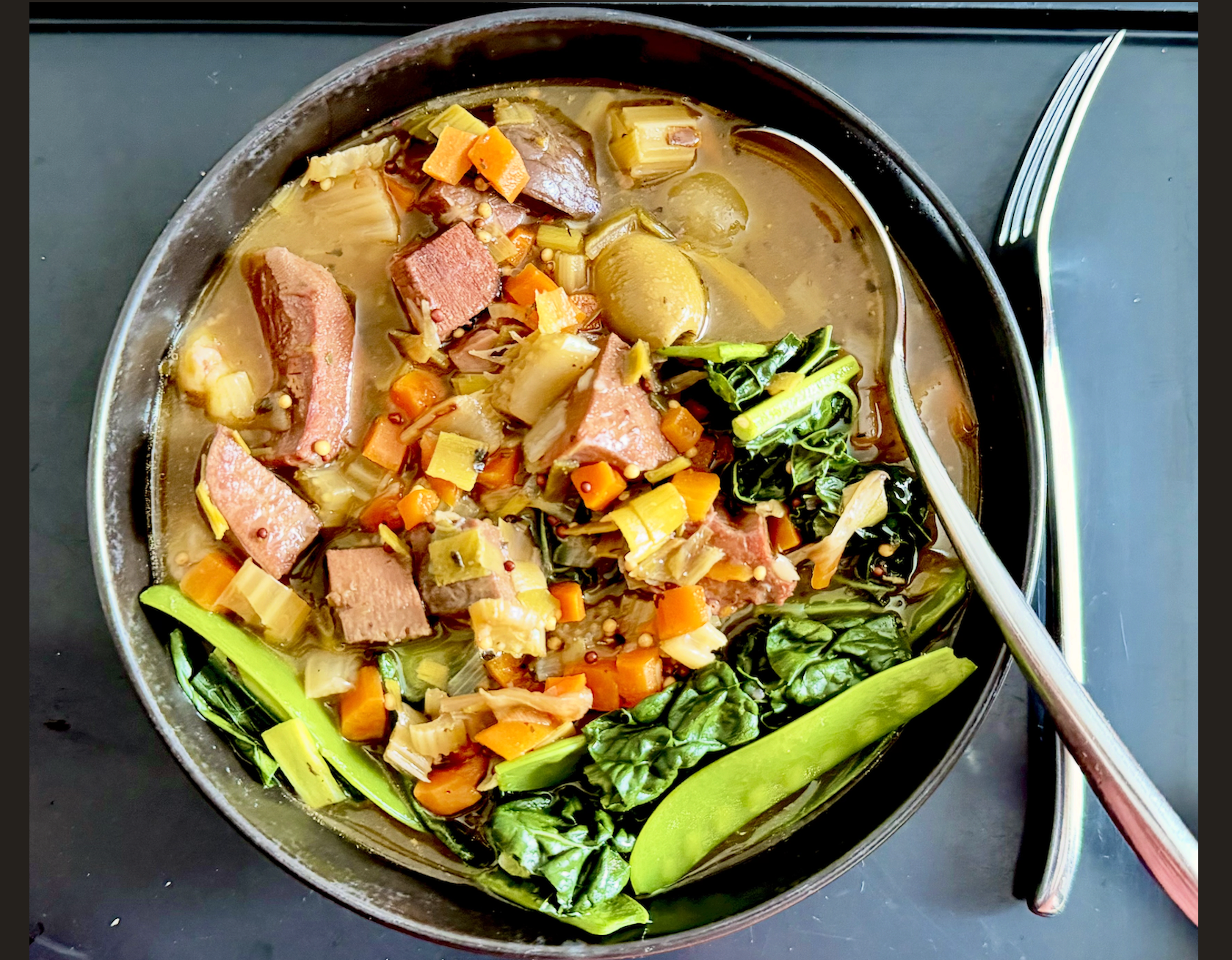
serving suggestion
Recipe
Serves 4
Preparation: 45 minutes
Cooking Time: ~2 hours
Equipment: large pot / stock pot / or slow cooker
Ingredients
1 small beef tongue (1.2-1.4 kg)
4 cloves
fresh stems of parsley (roughly chopped)
2 cloves of garlic
4 peppercorns
8 pink peppercorns
1/4 tsp all spice
Mirepoix
2 red onions (chopped, brunoise)
6 medium carrots (chopped, brunoise)
4 sticks of celery (chopped, brunoise)
1 small leek (chopped, brunoise)
2 cloves of garlic
Broth
1 litre bone broth (or vegetable broth), hot
2 bay leaves (or bouquet garnis)
4 cloves
fresh stems of parsley (roughly chopped)
2 cloves of garlic
4 peppercorns
8 pink peppercorns
1/4 tsp allspice
Mustard infusion
2 heaped tbsp wholegrain mustard
150 g green olives, pitted (I like them marinated in wild garlic for extra flavour)
1 levelled tsp arrowroot or corn flour to thicken (if necessary)
Season with salt and pepper
Extra
1 bunch cavalo nero (roughly chopped)
100 g fine gree beans
100 g mange-tout
French mash potatoes
6-8 medium potatoes
100 ml double cream or crème fraîche (warm)
75 g butter (at room temperature)
Salt and pepper to taste
Method
Fill a large pot with water, add the tongue whole and boil for 45 minutes. Discard the water, rinse the tongue under cold water and clean the pot thoroughly.
In the pot, melt the mirepoix on low heat with the lid on, stirring from time to time, until the onions appear translucent. Do not burn.
Fill the pot with the broth ingredients.
Once cooled a little, peel the tongue. It is very easy to use a vegetable peeler if you are not confortable with a knife.
Dice the tongue into cubes of one- or two-inch sides. Some people prepare slices, this is fine too.
Add the tongue to the broth and cover the pot. If you need more liquid, add 1 litre hot water, or more bone or vegetable broth. Bring to a boil again, then reduce to a simmer.
The tongue is ready when a knife easily pierces the meat pieces. This typically takes about 45-60 minutes
During this time, peel the potatoes, dice them and boil them until tender. I much prefer keeping the skin on for more flavour.
Once the potatoes are cooked, drain and mash by hand or use a mixer with a whisk attachment. Add the hot cream (but not boiling) and continue mashing/whisking, adding a little butter at a time, until completely smooth and fluffy.
20 minutes before the tongue is fully cooked, add the green olives, the whilegrain mustard. Taste and adjust seasoning if necessary.
When the tongue stew is ready, removed from the heat. Set the mash potao aside, ready to be served. Boil the vegetables for 3 minutes, drain and gather all the ingredietns.
Serve in dishes for a rustic recipe best shared or plate adding the mash potatoe, the steamed vegetables, and the stew over it.